
december, 2025
11dec14:0015:00The Heat is On: How Heat Stress Impacts the Apparel Industry, Jobs, and Worker Health
Event Details
Background The Heat is On: How Heat Stress Impacts the Apparel Industry, Jobs, and Worker Health examines the impacts of heat stress and flooding on
Event Details
Background
The Heat is On: How Heat Stress Impacts the Apparel Industry, Jobs, and Worker Health examines the impacts of heat stress and flooding on the apparel industry and its workforce. The research note, jointly prepared by Cornell University’s Global Labor Institute (GLI) and the International Finance Corporation (IFC), with input from the International Labour Organization’s (ILO) Better Work team, explores how climate change driven rising temperatures and extreme flooding are impacting the $1.77 trillion global apparel industry and its 90 million workers.
As heat waves and floods become more severe and frequent, worker health, productivity, job creation, and earnings are increasingly at risk. The analysis shows that by 2030, the apparel industries in Viet Nam, Cambodia, Pakistan, and Bangladesh could lose up to $65.8 billion in potential export earnings and create 1 million fewer new jobs due to climate impacts. By 2050, employment across these four countries could be 8.64 million lower if no adaptation measures are taken. Extreme weather is already disrupting production, delaying orders, and threatening workers’ health and incomes.
But despite these challenges, there is reason for optimism. Across the apparel sector, action is already underway. Governments are introducing and enforcing new standards on workplace heat, ventilation, rest breaks, and access to water. Global brands are adopting voluntary standards to better manage extreme heat and flooding risks across their supply chains. Manufacturers are training workers to identify and respond to heat stress and related illnesses. Meanwhile, cooling initiatives like the Global Cooling Pledge and Beat the Heat are helping manufacturers adapt to extreme heat, while reducing emissions.
This session forms part of the Cool Talks webinar series, which spotlights innovative solutions, policies, and partnerships across the sustainable cooling landscape.
Objectives
- Present key findings from The Heat is On, underscoring how rising temperatures and flooding are disrupting apparel production, threatening worker health, and limiting job creation across major manufacturing countries.
- Explore the role of sustainable cooling through standards, training, and technology in safeguarding workers, maintaining productivity, and building climate-resilient supply chains.
- Situate these challenges and responses within global frameworks like the Global Cooling Pledge and Cool Coalition efforts, highlighting opportunities for cross-sector collaboration and just adaptation.
Agenda
14:00 – 14:07
Welcome and Opening
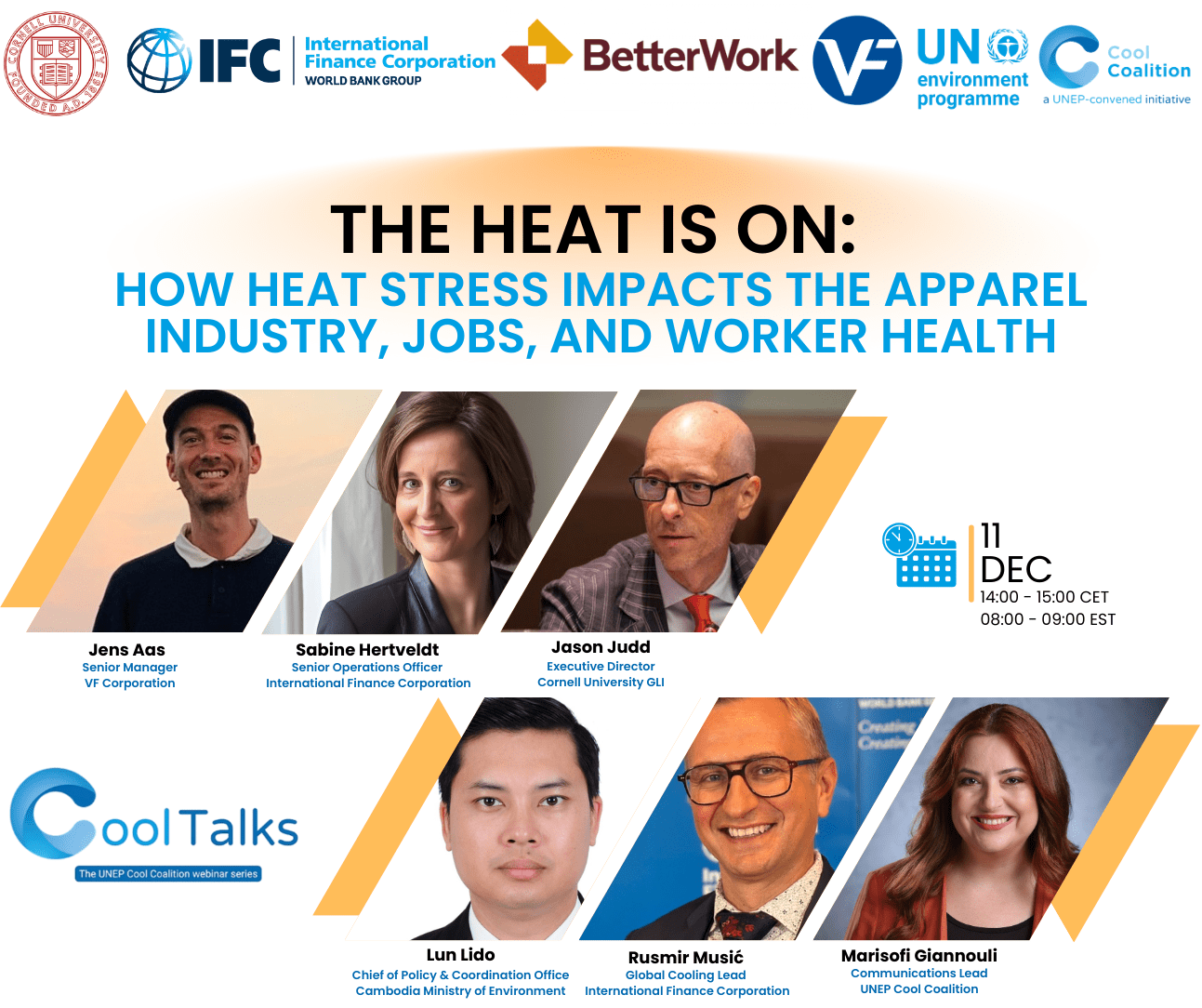
Marisofi Giannouli, Communications Lead, UNEP Cool Coalition
14:07– 14:37
Panel Discussion: The Heat is On Insights
Moderator: Sabine Hertveldt, Senior Operations Officer, Manufacturing, Agribusiness and Services, IFC
- Jason Judd, Executive Director, Cornell University School of Industrial and Labor Relations Global Labor Institute
- Jens Aas, Senior Manager, Worker & Community Development and Supply Chain Sustainability, VF Corporation
- Rusmir Musić, Global Cooling Lead, IFC
14:37 – 14:42
Keynote Speech: Labour and Cooling in the Fight Against Extreme Heat
Lun Lido, Chief of Policy & Coordination Office, Ministry of Environment, Cambodia
14:42– 14:57
Q&A Session
Moderator: Rusmir Musić, Global Cooling Lead, IFC
14:57 – 15:00
Closing Remarks
Marisofi Giannouli, Communications Lead, UNEP Cool Coalition
Resources
Time
(Thursday) 14:00 - 15:00 CET