Explore our curated collection of policy briefs and technical reports that illuminate the science, technology and governance needed to cut cooling‑related pollution and mitigate global warming. Stay informed with the latest evidence and actionable insights from leading experts in the field.

Roadmap for Extreme Heat Protection Through Passive Cooling in ASEAN Region

The Roadmap for Extreme Heat Protection through Passive Cooling in the ASEAN Region, developed by the ASEAN Centre for Energy and the United Nations Environment Programme through the Cool Coalition and EmPower, sets out a regional framework to address rising heat risks driven by rapid urbanisation, climate change and growing energy demand. It positions passive cooling as the first line of response, prioritising building design, materials and nature-based solutions to reduce cooling needs before mechanical systems are introduced. Combining policy, finance and technical recommendations, the roadmap highlights a critical gap between interest and implementation, and provides actionable pathways for ASEAN Member States to strengthen resilience, reduce energy demand and protect vulnerable populations.

Show more
ASEAN

Global Cooling Pledge Progress Report 2025

This second Global Cooling Pledge Progress Report provides a comprehensive overview of how countries are translating commitments into action across policy, planning, and implementation. It highlights progress in advancing access to sustainable cooling, improving energy efficiency, and accelerating the uptake of climate-friendly technologies, while also identifying key gaps in finance, data, and delivery. Drawing on country submissions and sectoral insights, the report reflects growing momentum and stronger alignment between national strategies and on-the-ground implementation. It also outlines priority areas for coordinated support, positioning the Global Cooling Pledge as a central platform to drive systemic, equitable, and scalable cooling solutions.

Show more
GCP PR 25

Action Plan Report on Urban Cooling for Can Tho City

Developed to address the rising demand for sustainable cooling in Viet Nam’s Mekong Delta, this Action Plan offers an evidence-based roadmap to reduce urban heat, enhance thermal comfort, and improve energy efficiency in Can Tho City. It combines microclimate analysis, building simulations, and policy mapping to deliver targeted recommendations for city planners and decision-makers. While tailored to the local context, the Plan presents a scalable framework that can inform urban cooling strategies in other rapidly growing tropical cities around the world.

Show more
UCCT

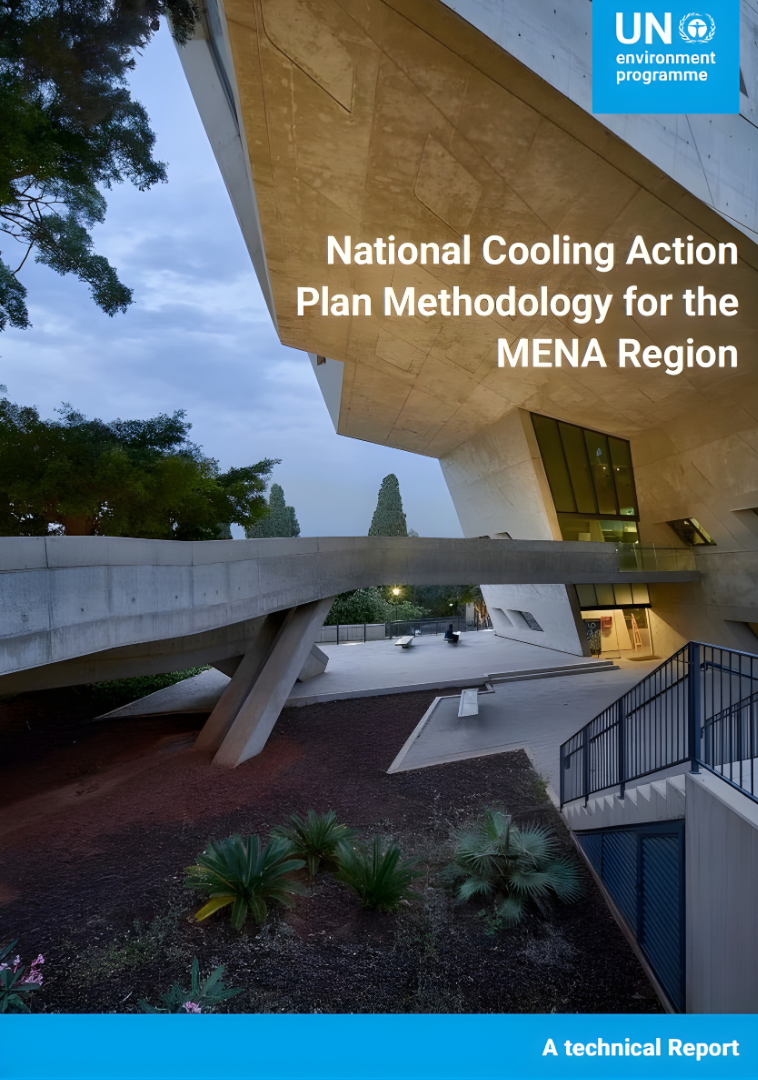
National Cooling Action Plan Methodology for the MENA Region

The National Cooling Action Plan Methodology for the MENA Region provides a practical framework to support governments in developing integrated cooling strategies aligned with climate, energy, and development priorities. Developed by the UN Environment Programme Cool Coalition in partnership with the Regional Center for Renewable Energy and Energy Efficiency (RCREEE), with financial support from the Climate and Clean Air Coalition (CCAC), the methodology adapts the global NCAP approach to the specific conditions of high-ambient-temperature countries in the Middle East and North Africa. The report outlines a structured process to assess cooling demand, strengthen coordination across sectors, and translate national commitments into implementable policies and investment pipelines covering buildings, appliances, refrigerants, cold chains, and energy systems. By linking cooling access, energy efficiency, and emissions reduction within a single planning framework, the methodology supports countries in developing National Cooling Action Plans that move from pledges to implementation while aligning with the Paris Agreement, the Kigali Amendment, and the Global Cooling Pledge.

Show more
NCAP

Guidelines for Passive Cooling Strategies in Cambodia

The Guidelines for Passive Cooling Strategies in Cambodia provide a practical, climate-responsive resource to support the design and delivery of buildings that reduce reliance on mechanical cooling while ensuring thermal, visual, and acoustic comfort. Tailored to Cambodia’s hot-humid context, the publication offers clear guidance on the selection, application, and integration of passive cooling strategies at site, building, and component levels. Drawing on technical analysis, building typologies, and real-world demonstration projects, the Guidelines bridge theory and practice and support architects, engineers, policymakers, and other stakeholders in embedding passive cooling into building design, regulations, and implementation, contributing to lower energy demand, reduced emissions, and improved urban resilience.

Show more
PCG

Global Cooling Watch 2025

The second edition of UNEP’s Global Cooling Watch Report takes a deep dive into one of the decade’s most urgent challenges: surging heat, soaring cooling demand, and stark inequalities in access.  Building on the 2023 edition’s analysis of global sustainable cooling trends, the report provides the scientific foundation for the Global Cooling Pledge and charts pathways toward near-zero emissions from cooling. 

Show more
Free degrees

Handbook for Urban Heat Management in the Global South

Extreme heat is reshaping life in cities. For millions of people, especially in fast-growing urban areas of the Global South, higher temperatures are making it harder to earn a living, attend school, access healthcare, or move safely throughout the day. Extreme urban heat and lack of sustainable cooling is threatening productivity, deepening inequality, and increasing the risk of displacement when communities can no longer cope. Cities cannot afford to treat extreme heat as a seasonal inconvenience. Without action, heat will erode livelihoods and overwhelm urban infrastructure and services. It will fuel unemployment, drive internal and cross-border migration, and put massive demands on energy systems. Cities must act now to manage rising temperatures before it is too late. The Handbook on Urban Heat Management in the Global South, developed by the World Bank in partnership with the United Nations Human Settlements Programme (UN-Habitat) and the United Nations Environment Programme (UNEP), offers a practical response. It brings together real examples and strategies from cities that are already tackling extreme heat. It focuses on powerful solutions that are feasible, affordable, and easy to adapt - especially those that expand access to accessible, sustainable cooling.

Show more
Handbook for Urban Heat Management in the Global South

NDCs Cooling Guide

A practical framework for integrating sustainable cooling into national climate commitments. This guide provides a six-step approach for embedding sustainable cooling into Nationally Determined Contributions (NDCs), supported by case studies and technical tools. It includes guidance on emissions assessments, target-setting, policy design, and implementation of measures such as MEPS, refrigerant phase-down, and passive cooling strategies.

Show more
NDC cooling guide

Advancing City-Level Heat Action Plans

As India and many other countries face intensifying extreme heat, the need for robust, city-level Heat Action Plans (HAPs) has become urgent. In February 2025, the UNEP Cool Coalition partnered with India’s National Disaster Management Authority (NDMA) to co-host an international workshop focused on advancing HAPs as tools for both emergency response and long-term heat resilience.

Bringing together over 15 Cool Coalition partners and global experts, the workshop showcased best practices such as passive cooling, Urban Heat Island mapping, and the Chief Heat Officer model. Key outcomes included strengthening coordination across governance levels, scaling innovative cooling for vulnerable populations, and integrating sustainable cooling into urban redesign.

Show more
NDMAP

Compendium for Passive Cooling Strategies in Cambodia

The Compendium for Passive Cooling Strategies in Cambodia serves as a practical guide for integrating passive cooling strategies into Cambodia’s building sector. Tailored for architects, engineers, building owners, and professionals in construction and maintenance, it highlights three key types of strategies: site-oriented, design-oriented, and material/technology-oriented measures. Each section offers clear technical insights, practical application steps, and helpful tools to assist in selecting the most effective passive cooling options for projects. Beyond the core strategies, the compendium also includes a material directory and international case studies, providing additional support for the successful adoption of these solutions. 

The Compendium was developed and published by the Ministry of Environment of Cambodia. This work was made possible through the technical and financial support of the United Nations Economic and Social Commission for Asia and the Pacific (ESCAP), the United Nations Environment Programme (UNEP) Cool Coalition, and the ClimateWorks Foundation, whose contributions were crucial to its development.

Show more
The Compendium for Passive Cooling Strategies in Cambodia