Showing 830 results
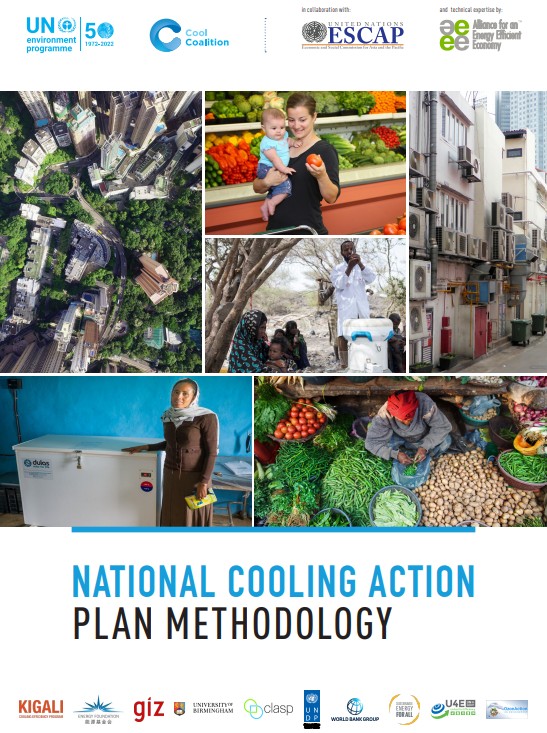
National Cooling Action Plan Methodology
The National Cooling Action Plan (NCAP) Methodology provides countries with a practical, adaptable framework for developing comprehensive national cooling strategies tailored to their specific priorities, resources and capacities. Developed by the UNEP-led Cool Coalition with UN ESCAP and technical partners, the methodology guides countries through three stages: assessing the national cooling context, analysing current and future cooling demand across key sectors, and translating this evidence into prioritized recommendations, implementation pathways and an actionable NCAP. It is designed to help countries expand access to cooling while reducing energy use, emissions and climate impacts, and to align cooling action with wider national development and climate priorities.
The Cooling Imperative: Forecasting the size and source of future cooling demand
The report is an Economist Intelligence Unit (EIU) report commissioned by the Kigali Cooling Efficiency Program (K-CEP). It forecasts the size and source of future cooling demand out to 2030, and quantifies the need to transition to more efficient, climate-friendly cooling, and maps out what this transition could look like. Driven by climate change, urbanisation and income growth, demand for cooling – refrigeration and air conditioning – is on a rapid growth trend. The EIU estimates that 4.8bn new units of cooling equipment will be sold globally between 2019 and 2030. The growing demand for cooling that our forecasts highlight must be met – and quickly. The uptick in cooling demand will come on top of an already substantial “cooling gap”. Scaling up affordable access to cooling will be critical if countries are to meet the Sustainable Development Goals, particularly in the areas of food security, health, education, employee productivity and equality. The EIU’s report highlights the urgent steps that must be taken to avoid the need for cooling, shift to cooling with lower emissions, improve cooling efficiency, and protect those most vulnerable to a lack of cooling.
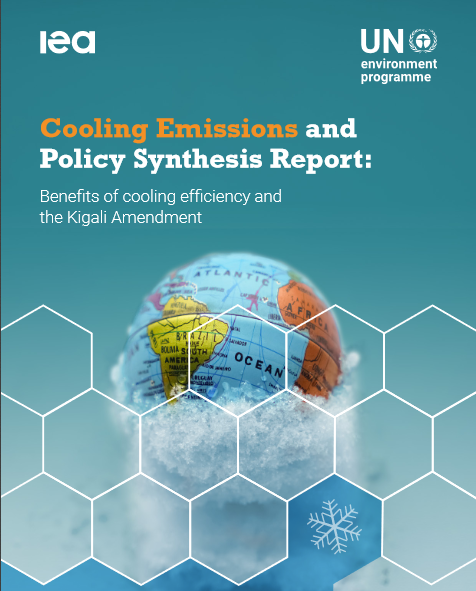
Cooling Emissions and Policy Synthesis Report
Action under the Kigali Amendment to the Montreal Protocol on Substances that Destroy the Ozone Layer (Montreal Protocol) will phase-down the production and use of hydrofluorocarbons (HFCs) and could avoid up to 0.4°C of global warming by 2100.
In a warming world, prosperity and civilization depend more on access to cooling.i The growing demand for cooling will contribute significantly to climate change. This is from both the emissions of HFCs and other refrigerants and CO2 and black carbon emissions from the mostly fossil fuel-based energy powering air conditioners and other cooling equipment. These emissions are particularly dominant during periods of peak power demand, which are increasingly determined by demand for air conditioning. As the climate warms, the growing demand for cooling is creating more warming in a destructive feedback loop.
By combining energy efficiency improvements with the transition away from super-polluting refrigerants, the world could avoid cumulative greenhouse gas emissions of up to 210-460 gigatonnes of carbon dioxide equivalent (GtCO2e) over the next four decades, depending on future rates of decarbonisation. This is roughly equal to 4-8 years of total annual global greenhouse gas emissions, based on 2018 levels.
UK Leadership on sustainable cooling
Cooling is critical for health, prosperity, and the environment. From keeping vaccines and food fresh to ensuring comfortable home and work environments. It is also essential to adapt to warmer temperatures, which is difficult as most cooling is highly polluting due to the refrigerants used and the emissions from electricity generated to power cooling equipment. Sustainable cooling for all underpins many Sustainable Development Goals (SDGs), including SDG 7 on achieving sustainable energy for all by 2030, and SDG 13 on climate action. Today over 1.1 billion people are at significant risk from a lack of access to cooling and continued warming and demographic changes are likely to see these risks grow.
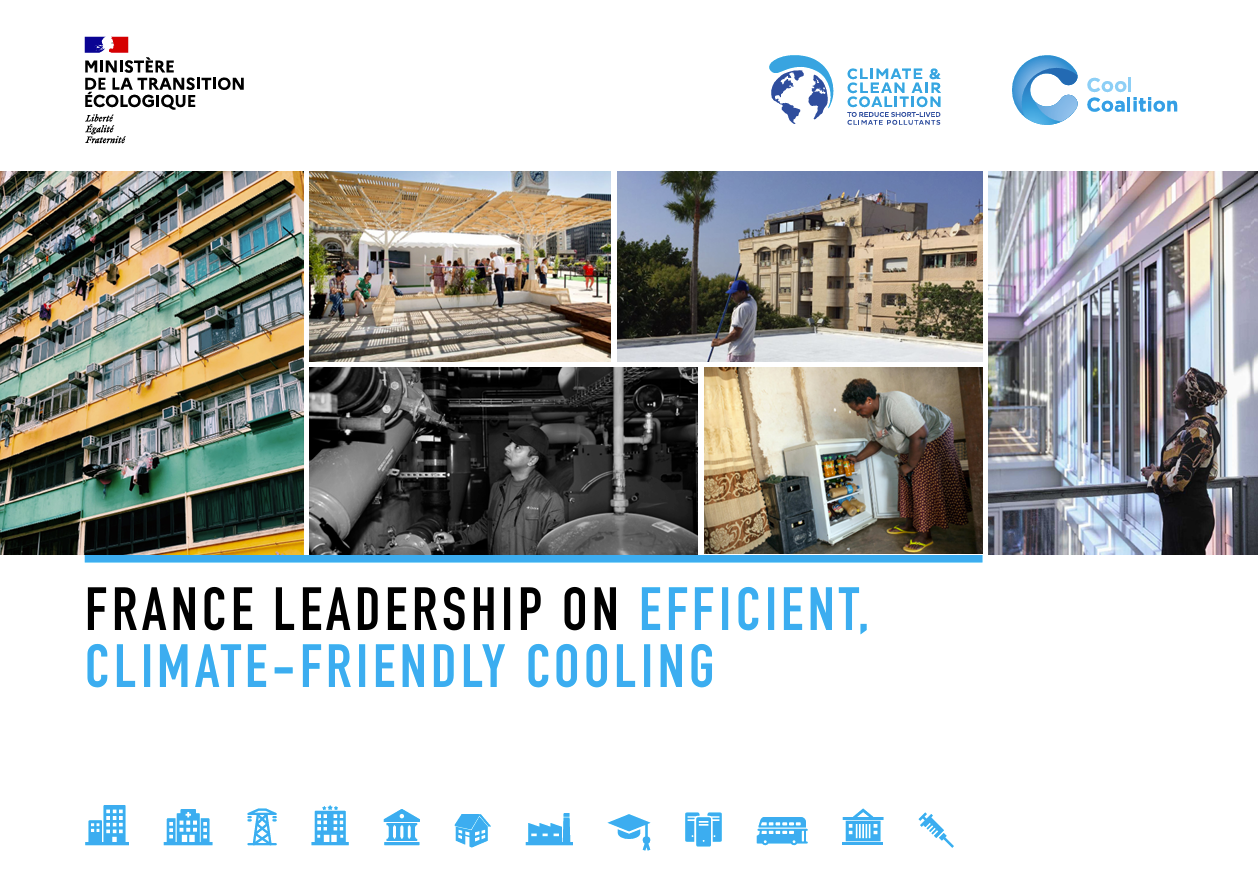
France Leadership on Efficient, Climate-Friendly Cooling
Cooling is critical for health, prosperity, and the environment. From keeping vaccines and food fresh to ensuring comfortable home and work environments. It is also essential to adapt to warmer temperatures, which is difficult as most cooling is highly polluting due to the refrigerants used and the emissions from electricity generated to power cooling equipment. Sustainable cooling for all underpins many Sustainable Development Goals (SDGs), including SDG 7 on achieving sustainable energy for all by 2030, and SDG 13 on climate action. Today over 1.1 billion people are at significant risk from a lack of access to cooling and continued warming and demographic changes are likely to see these risks grow.
Beating the Heat: A Sustainable Cooling Handbook for Cities
Beating the Heat: A Sustainable Cooling Handbook for Cities was launched on November 3rd 2021 at COP26 by the Cool Coalition, UNEP, RMI, Global Covenant of Mayors for Climate & Energy (GCoM), Mission Innovation and Clean Cooling Collaborative.
The new guide offers planners an encyclopaedia of proven options to help cool cities. The guide’s 80 supporting case studies and examples demonstrate the effectiveness of the strategies outlined and can help cities find an approach best suited to their unique contexts.

Sustainable Food Cold Chains: Opportunities, Challenges and the Way Forward
An estimated 14 percent of the total food produced for human consumption is lost, while 17 per cent is wasted. This is enough to feed around 1 billion people in a world where currently 811 million people are hungry and 3 billion cannot afford a healthy diet. The lack of effective refrigeration is a leading contributor to this challenge, resulting in the loss of 12 percent of total food production, in 2017. Moreover, the food cold chain is responsible for 4 percent of global greenhouse gas emissions, including from cold chain technologies and food loss and waste due to lack of refrigeration.
This report explores how food cold chain development can become more sustainable and makes a series of important recommendations. These include governments and other cold chain stakeholders collaborating to adopt a systems approach and develop National Cooling Action Plans, backing plans with financing and targets, implementing and enforcing ambitious minimum efficiency standards.
The Montreal Protocol on Substances that Deplete the Ozone Layer – a universally ratified multilateral environmental agreement – can contribute to mobilizing and scaling up solutions for delivering sustainable, efficient, and environmentally friendly cooling through its Kigali Amendment and Rome Declaration. Reducing non-CO2 emissions, including refrigerants used in cold chain technologies is key to achieve the Paris Agreement targets, as highlighted in the latest mitigation report from the Intergovernmental Panel on Climate Change (IPCC).
At a time when the international community must act to meet the Sustainable Development Goals, sustainable food cold chains can make an important difference.

Resource
Global Cooling Pledge
At the 2023 United Nations Climate Change Conference (COP28), the Cool Coalition launched the Global Cooling Pledge. Currently boasting over 70 country Signatories and 80 non-state supporters, the Pledge represents the world’s first collective commitment to reducing cooling-related emissions by 68% by 2050, while also expanding equitable access to cooling. It is anchored in the science of the Global Cooling Watch and lays out 14 national targets, including National Cooling Action Plans, passive and nature-based solutions, building energy codes, higher efficiency standards, and refrigerant phase-down.
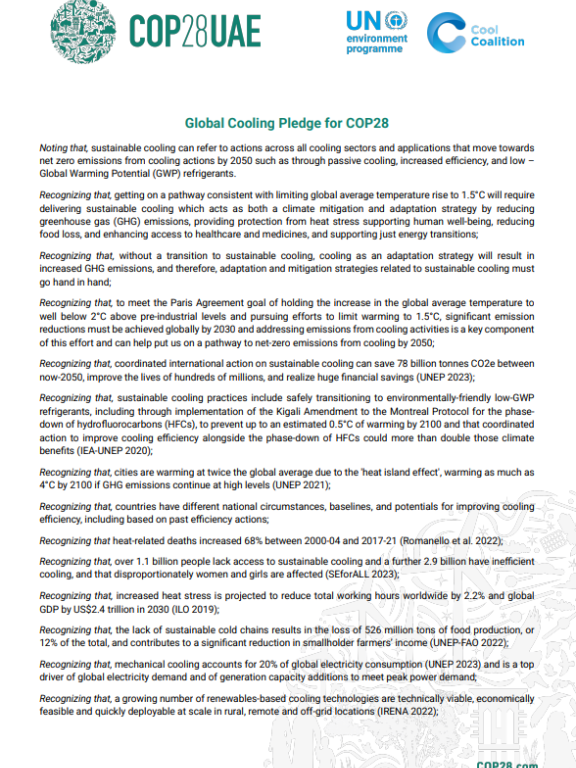
Global Cooling Pledge
At the 2023 United Nations Climate Change Conference (COP28), the Cool Coalition launched the Global Cooling Pledge. Currently boasting over 70 country Signatories and 80 non-state supporters, the Pledge represents the world’s first collective commitment to reducing cooling-related emissions by 68% by 2050, while also expanding equitable access to cooling. It is anchored in the science of the Global Cooling Watch and lays out 14 national targets, including National Cooling Action Plans, passive and nature-based solutions, building energy codes, higher efficiency standards, and refrigerant phase-down.

Global Cooling Watch 2023
The Global Cooling Watch is UNEP's biennial publication on sustainable cooling. The inaugural edition on 2023 presents a data-driven roadmap to achieve near-zero emissions from cooling. It models realistic, high-impact pathways across key sectors and lays out three major pillars for action: passive cooling, energy efficiency, and refrigerant transition. Released in support of the Global Cooling Pledge, the report calls on governments to accelerate solutions that reduce emissions and expand access.
