Showing 759 results
News
Regional Advisory Group Launches for NCAPs in MENA
News
From Commitments to Action: Cool Coalition Steering Committee Sets Path for 2025–2026
Publication
United Nations Secretary-General's Call to Action on Extreme Heat
The UN Secretary-General's Call to Action on Extreme Heat brings together the diverse expertise and perspectives of ten specialized UN entities (FAO, ILO, OCHA, UNDRR, UNEP, UNESCO, UN-Habitat, UNICEF, WHO, WMO) in a first-of-its-kind joint product, underscoring the multi-sectoral impacts of extreme heat. In support of the Call to Action, the Global Heat Health Information Network launched a set of Heat Action profiles, mapping heat-related work across 16 UN and international organizations.
Publication
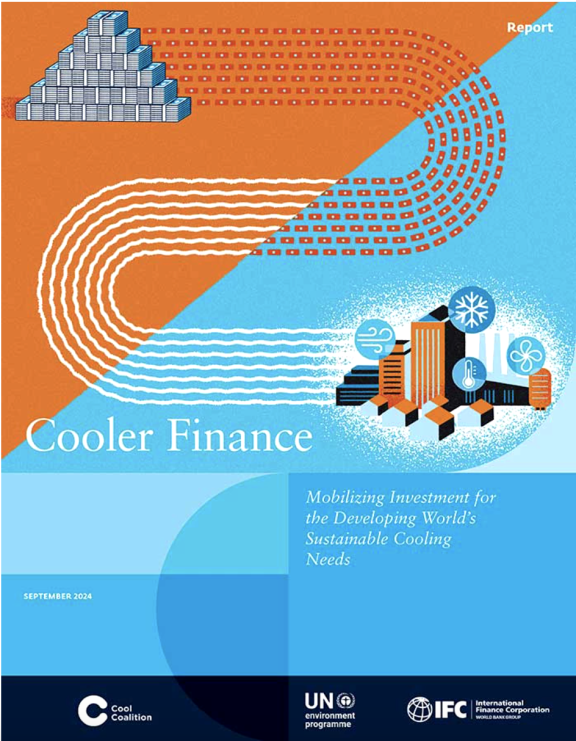
Cooler Finance: Mobilizing Investment for the Developing World's Sustainable Cooling Needs
Rising global temperatures mean demand for cooling in homes, workplaces, and across supply chains is accelerating, particularly in developing economies where the impact of extreme heat is already being felt most acutely.
Heat-related deaths are running at an annual average close to 500,000 globally, highlighting the urgency of boosting access to cooling. As well as averting fatal outcomes, ensuring populations have access to cooling – for human comfort as well as preserving perishable goods – means workers are more productive, farmers can deliver produce to market before it spoils and healthcare services can provide lifesaving vaccines.
But more intensive use of refrigeration and air conditioning could trigger surges in energy demand, putting stress on power grids and potentially generating higher greenhouse gas emissions that fuel yet more warming. That means new cooling solutions must be sustainable, based on energy efficient technology and maximizing reliance on so called passive strategies, such as making use of shade, or building with reflective materials.
These come at a cost, however, with passive design as well as new and efficient equipment for space cooling and refrigeration beyond the reach of many firms and households in developing countries. But effective interventions by governments, multilateral institutions, and donor organizations could make the financing and provision of sustainable cooling solutions in developing economies an attractive opportunity for private investors.
A new analysis from IFC and the United Nations Environmental Programme (UNEP) finds that the market for sustainable cooling in developing economies is set to more than double over the next 25 years from around $300 billion in annual demand currently. That means the business opportunity for investors will amount to at least $600 billion in annual demand by 2050, most of which will be attributed to active cooling.
The study also finds that adopting sustainable cooling solutions, as opposed to inefficient equipment that uses more power, could cut emerging economy consumers’ electricity bills by as much as $5.6 trillion over the next 25 years. It will also reduce the amount of new investment needed in additional power generation to meet peak electricity demand by $1.8 trillion.
Publication
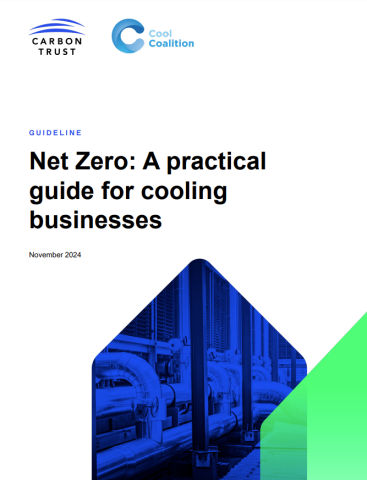
Net Zero: A practical guide for cooling businesses
Primarily aimed at the manufacturers and value chains of heating, ventilation and air conditioning (HVAC) systems, refrigeration systems (e.g. fridges), and the refrigerant gases used in these systems (e.g. hydrofluorocarbons), the guide’s purpose is to share experiences and examples of how cooling businesses have embarked upon their decarbonisation journeys.
It includes a range of practical advice and support to cooling businesses early in their climate journey on the steps, actions and processes needed to achieve Net Zero, and shares best practices to help overcome recognised barriers and material challenges to achieving it.
The guide includes:
- An outline of the drivers causing the rise in demand for cooling solutions and the benefits of cooling to the global population
- The importance of decarbonisation and its impacts on businesses, including opportunities and risks. The levers that cooling businesses can utilise to reduce their greenhouse gas (GHG) emissions
- Insights into some of the regulations driving Net Zero action before exploring what Net Zero is and the approaches required to achieve it.
The final two sections of the guideline focus on the main sources of GHG emissions for cooling businesses through a heatmap analysis and outline the seven steps that strategically guide decarbonisation efforts, i.e. the Net Zero decarbonisation pathway.
Publication
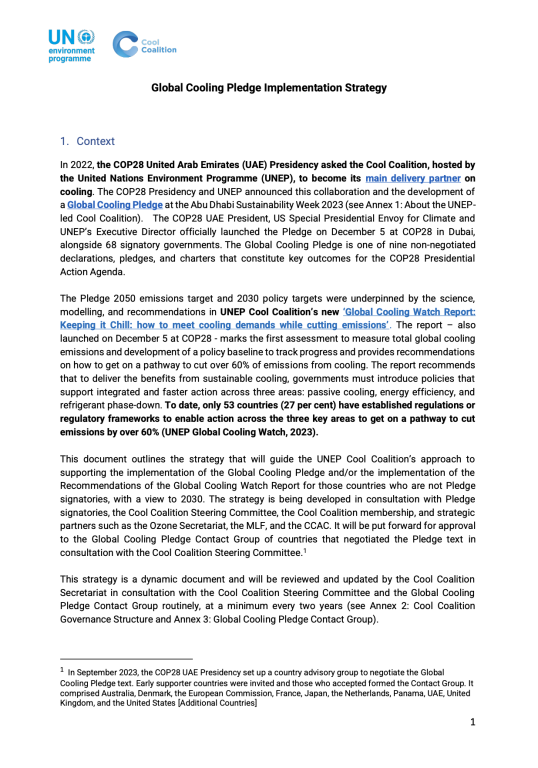
2030 Global Cooling Pledge Implementation Strategy
2030 Global Cooling Pledge Implementation Strategy outlines the strategy that will guide the UNEP Cool Coalition’s approach to supporting the implementation of the Global Cooling Pledge and/or the implementation of the Recommendations of the Global Cooling Watch Report for those countries who are not Pledge signatories, with a view to 2030.
Resource
Global Cooling Pledge Progress Report 2024
This first official progress report outlines country actions and sectoral efforts taken in support of the Global Cooling Pledge. It highlights policy updates, implementation milestones, and early results from national commitments, providing a snapshot of collective momentum toward sustainable and equitable cooling. The Global Cooling Pledge Progress Report 2024 was endorsed during the inaugural Cooling Ministerial Dialogue, held at the 2024 UN Climate Change Conference (COP29).
Resource
2030 Global Cooling Pledge Implementation Strategy
2030 Global Cooling Pledge Implementation Strategy outlines the strategy that will guide the UNEP Cool Coalition’s approach to supporting the implementation of the Global Cooling Pledge and/or the implementation of the Recommendations of the Global Cooling Watch Report for those countries who are not Pledge signatories, with a view to 2030.
Publication
Global Cooling Pledge Progress Report 2024
This first official progress report outlines country actions and sectoral efforts taken in support of the Global Cooling Pledge. It highlights policy updates, implementation milestones, and early results from national commitments, providing a snapshot of collective momentum toward sustainable and equitable cooling. The Global Cooling Pledge Progress Report 2024 was endorsed during the inaugural Cooling Ministerial Dialogue, held at the 2024 UN Climate Change Conference (COP29).
News
The Cool Future: Exploring Sustainable District Cooling Solutions from the MENA Region to Europe