Showing 739 results
Litchi Cold Chain Guidelines
Litchi, a highly perishable fruit, holds significant economic importance in Bihar, where it is extensively cultivated and contributes to the livelihood of many farmers. The rapid deterioration of litchi due to its high moisture content and susceptibility to browning poses challenges in maintaining its marketability. Effective post-harvest management and robust cold chain practices are crucial in extending the fruit’s shelf life, preserving its nutritional value, and maintaining its market appeal.
This document provides comprehensive guidelines to optimize the litchi cold chain in Bihar, focusing on best practices to maintain the fruit’s quality throughout its journey from farm to market. United Nations Environment Programme (UNEP) Cool Coalition in partnership with the Alliance for an Energy Efficient Economy (AEEE) are providing technical assistance to Bihar’s Department of Agriculture under the India Cold-Chain Programme (ICCP). Through its Directorate of Horticulture, the Department has recommended developing specific cold chain guidelines for litchi in Bihar. This document aims to provide these guidelines, tailored to the state’s needs and can be shared with the Department of Horticulture, the Department of Industry, and Farmer’s Producer Companies (FPCs) to benefit smallholder farmers, cold chain operators, and other stakeholders involved in the litchi value chains.
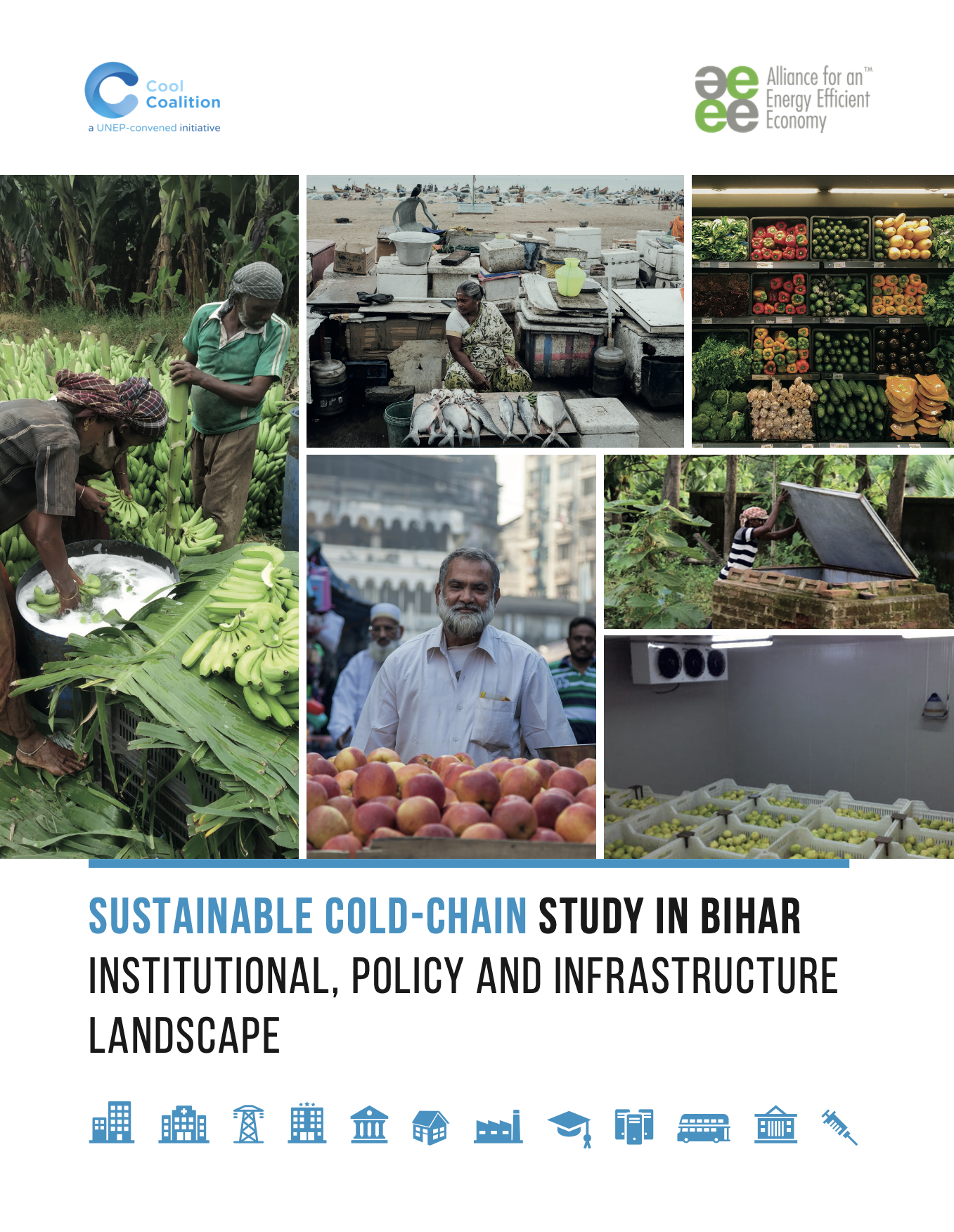
Sustainable Cold-Chain Study in Bihar
This study brings to light Bihar's horticulture cold-chain scenario, describing the policy and institutional landscape, discussing the present status of cold-chain infrastructure in Bihar, estimating the GHG emissions due to lack of post-harvest infrastructure in the state, identifying gaps in cold-chain development and proposing recommendations to strengthen the cold-chain development in the state. The study's outcomes are captured in this report which begins with a brief overview of the need for cold-chain in the state, providing a background on the nation‘s and state‘s major produce and the impact of fragmented cold-chain on the produce and livelihoods of farmers.
The report summarises the barriers to cold-chain development in Bihar, including observations from various stakeholders consulted during the report‘s development, and proposes recommendations to overcome these barriers. The observations, findings, and recommendations based on our study presented in this report will advance cold-chain development in Bihar. They will be helpful to the state agencies, national actors and global agencies to develop an understanding of the need for an integrated cold-chain in Bihar and replicate similar studies for other states and regions.
Resource
Agenda
Show more
Resource
Presentations
Show more
Page
Registration and funding support

News
London’s Climate Action Week Turns Cooling into a Delivery Test

Event
Cooling Under Pressure: Water-Smart Solutions for Food Security and Heat Resilience

Event
Pathways to Accelerate Adoption of District Cooling in Uttar Pradesh

Resource
Case Study: Strengthening Policies and Investment for Clean and Efficient Cold Chain in Bihar
Show more
Resource